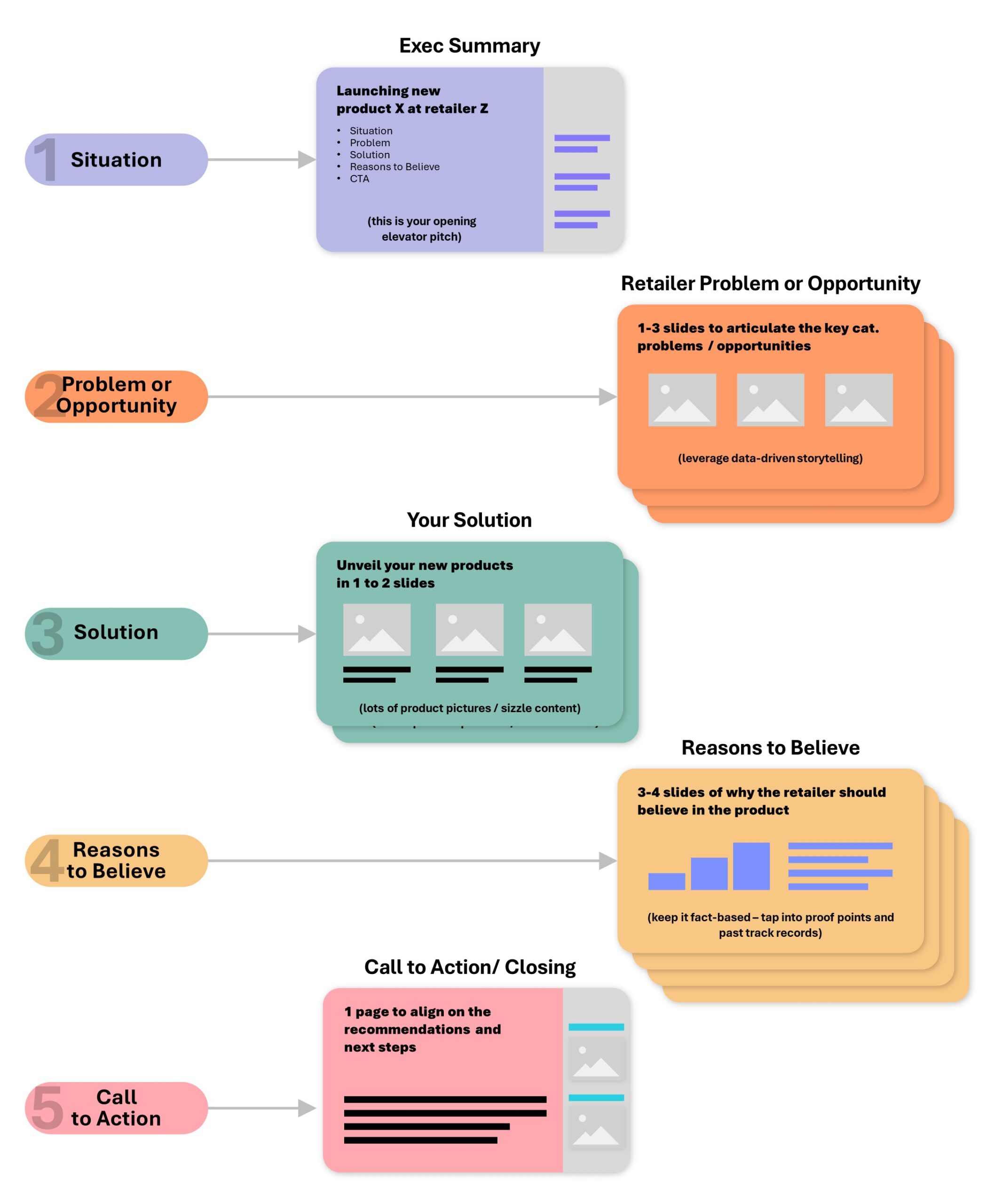
#1 What is a “Selling Story” for a new CPG product?
A Selling Story is a framework that gives retail buyers a compelling reason to say yes to a new product, instead of a pitch that just pushes the SKU. It works for any account exec presenting it, regardless of experience, because the structure carries the argument, not the presenter.
#2 What are the five steps in the Selling Story formula?
Situation, Problem or Opportunity, Solution, Reasons to Believe, and Call to Action. You level-set on why the category matters, name the problem or gap in it, present your product as the fix, back it with proof, and close with a clear ask for distribution.
#3 Why does a Selling Story start with “Situation” instead of the product?
Because the retailer needs a reason to care before they’ll hear the pitch. Starting with category-level context, like size and growth rate, sets up the “why care” up front, so data and insights can build a credible case for the solution instead of just listing features.
#4 How do you turn the Selling Story formula into slides?
Build one slide for each element you’ve already outlined, using data, insights, and visuals to land the message. A full deck runs about 10 slides: an exec summary, 1 to 3 slides on the problem or opportunity, 1 to 2 on the solution, 3 to 4 reasons to believe, and one call to action slide.
#5 What belongs in the “Reasons to Believe” section of a new product pitch?
Proof that the retailer should believe in the product, kept fact-based. That means leaning on proof points and past track record, like consumer testing results or launch plans, rather than just asserting the product will work.