We don’t build IR websites. But as a team that creates investor storytelling materials, we pay close attention to how that content gets found and used. This topic came up repeatedly at 2026 NIRI Conference, and it is becoming increasingly relevant to the work we do with clients.

Ask an AI tool to explain your company’s investment thesis. Where does it pull the answer from?

According to the Brunswick Group’s 2026 U.S. Investor Survey, 54% of institutional investors say AI outputs are now an important part of their research. Nearly half are skipping earnings calls and reviewing AI-generated summaries instead. That means the answer AI gives about your company matters, and it depends on what your IR website makes available.

If your IR website has clear, structured content, AI uses your own words. If it does not, it pieces your story together from media coverage, analyst commentary, and whatever else it can find. Your website is now a source of truth not just for people, but for the models powering these tools.

A few IR teams are already rethinking their websites with AI in mind. Here is what we are seeing.

Put your company’s story where AI tools can find it

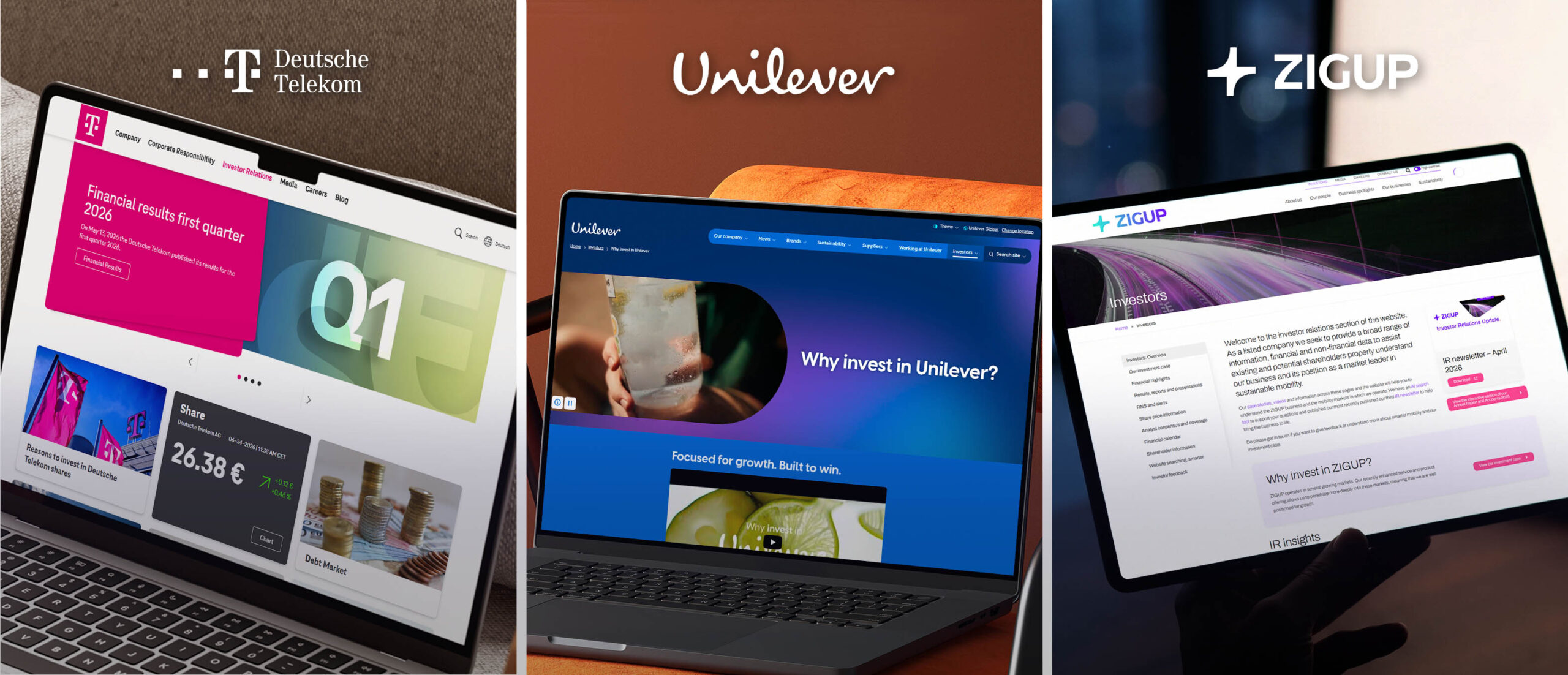
Deutsche Telekom’s IR website publishes a significant amount of content directly as structured web pages.

Management commentary, key figures, segment reporting, and quarterly context all live directly on the site, not just inside documents.

Each section of the quarterly report has its own web page: income statement, cash flows, balance sheet, segment performance, forecast, and risk factors. All of it is structured, navigable web content that AI tools can read and cite directly.

Unilever goes a step further, and arguably does the more important thing. It publishes the core investment narrative directly on its website. This is the kind of evergreen content that shapes how AI tools describe a company long after any single quarter is over.

Its “Why Invest in Unilever” page presents the complete investment thesis as structured web content: five investment pillars, key financial targets, geographic breakdowns, and a detailed value creation model. An AI tool can extract Unilever’s strategy, competitive positioning, and financial framework from a single page.

Their quarterly results pages go further. Each quarter gets its own web overview with headline metrics, CEO commentary, and a detailed FAQ that pre-answers the kinds of questions analysts actually ask.

Takeaway: Whether it is financial data or investment narrative, the principle is the same. The more of your company’s story that lives directly on your website as structured, readable web content, the more likely AI tools will use your own words when investors ask about you.

Bring AI search into the investor website

ZIGUP takes a different approach entirely. Rather than just publishing content for AI tools to find externally, it brings AI search directly into the IR website itself.

Instead of asking visitors to browse through pages and documents first, its AI Assistant lets them ask questions across the company’s website and public materials. A question like “What is your investment thesis?” can return a structured answer on the business, market position, growth opportunities, and shareholder return profile.

That changes the job of the IR website. It is no longer just organizing materials. It is helping investors get to answers.

But the assistant is only useful because there is actual IR content behind it, from the investment case and financial highlights to KPIs, results, reports, and presentations.

Takeaway: AI search is not just a website feature. It is a test of whether your IR content can answer the questions investors are likely to ask.

Things to consider as you update your IR website

You likely do not need to rebuild your IR website from scratch. Here are some things worth keeping in mind as you think about this.

Start with a simple test. Ask any of the major AI tools (ChatGPT, Claude, Google AI Mode), “What is [your company]’s investment thesis?” Compare the answers to the message your team actually wants investors to hear. Any gap between the two is a signal that content is missing from your website or not structured in a way AI tools can find.

Small additions go a long way. A clearly written investment overview, a strategy summary, or an FAQs section with real investor questions on your IR website can make a meaningful difference, even for lean teams.

JavaScript can be a blind spot. A 2024 study by Vercel and MERJ found that many major AI crawlers do not reliably execute JavaScript. If your IR site is JavaScript-heavy, some AI tools may see an empty page.

Ask your web team about schema markup. Schema markup (specifically JSON-LD) is a standardized way of labeling your web pages so AI tools and search engines can quickly identify what a page is about, whether it is an earnings release, a company overview, or an investor FAQs. Research from BrightEdge found that sites using structured data and FAQ schema saw a 44% increase in AI search citations. Your IR website provider or web team can implement this. The key is to ask them about it.

A word on governance and compliance

Two watchouts before you get started. First, someone needs to own which page is the current source of truth, update it after earnings, and retire stale claims. If the website says one thing and the latest filing says another, AI tools will surface the conflict.

Second, the goal is not to create new forward-looking claims to feed AI. It is to make your already-approved messaging easier to find and interpret. The best content for this is language that has already been through legal review: your investor presentation narrative, your prepared remarks, your strategic framework. Publish that, and you are on solid ground.

Missed our NIRI 2026 session?

At NIRI 2026, we ran a working session on building a one-page investment thesis and using it to structure your full investor presentation. We built one live for an IRO in the room, and she rated it 8 out of 10. If you couldn’t make it, the offer still stands. Book a 30-minute call with me and we’ll build your investor presentation outline live. 

How does your Presentation measure up?

Do you have a major event or a high-stakes meeting coming up? Do you need a sharp narrative and bold design?

Let's connect and we can take a closer look at your presentations. We'll share with you actionable ideas along with real examples that you can apply to improve odds of success.

Book an introductory call