3 New Ways IR Teams Are Putting AI to Work
Investors are doing more of their early research through AI tools. They are using AI to summarize filings, review investor materials, pull key figures, and compare companies across sectors. Before an investor speaks with your IR team or joins your earnings call, an AI tool has likely already given them a first take on your company.

We have been tracking how IR teams are responding, and three new approaches stood out to us. Each one leans on AI to make sure your version of the story is getting heard.

1/ Companies are adding AI assistants to their IR websites

When investors ask Claude, ChatGPT, or Google’s AI Mode about your company, the answer comes from across the web. It could be a news article, an analyst note, or last year’s outlook. The result can mix your disclosures with older or secondhand information, and you have no control over how it gets stitched together.

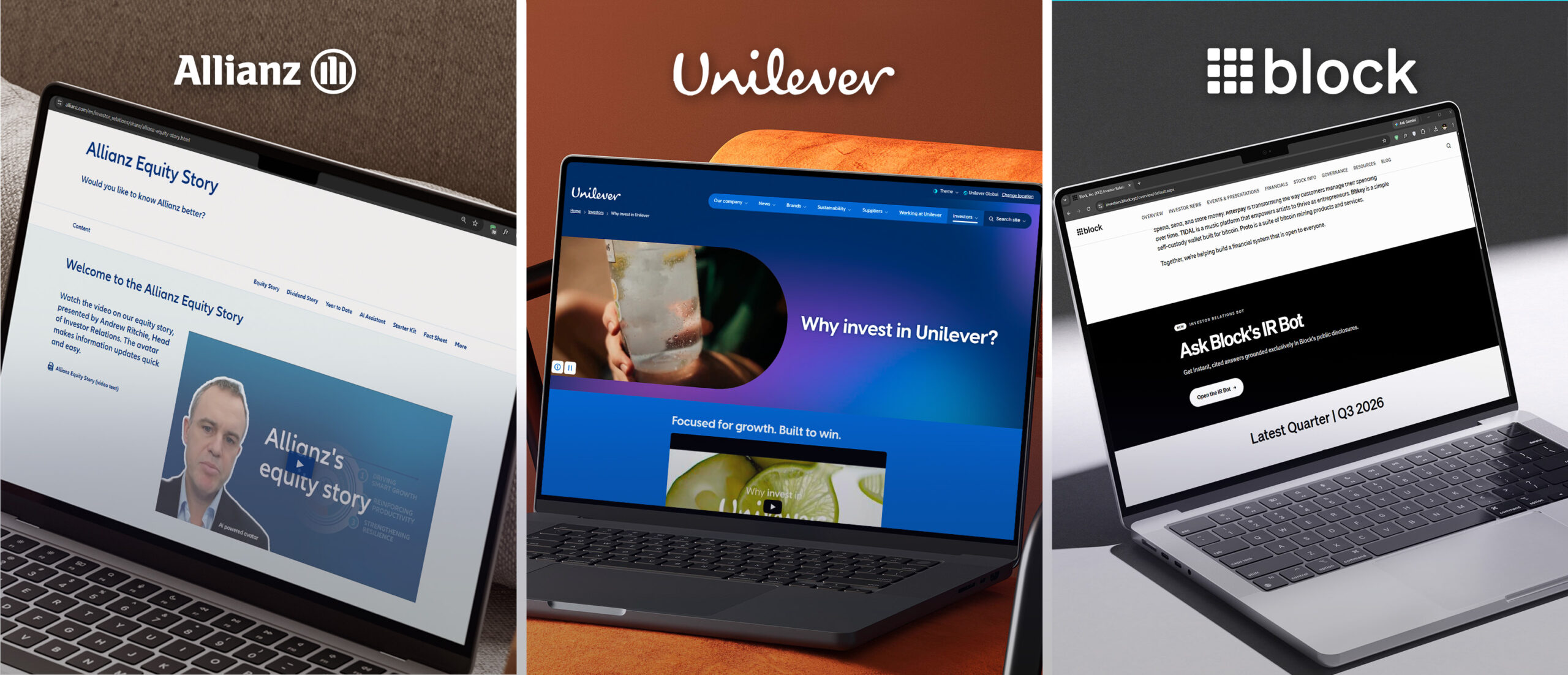
A few IR teams are getting ahead of this. Block, DHL Group, and others have added AI assistants directly to their IR websites, where investors can ask questions and get answers sourced only from the company’s published materials. Every answer comes with citations, so investors can trace any number back to where it came from.

Block built its IR Bot to cut down on repeat information requests, so its IR team can spend more time in actual conversations with investors. Every response pulls from Block's public disclosures and SEC filings.
On DHL Group's IR website, investors can ask its Research Assistant questions about the company's half-year results right on the page where those results are published. The assistant suggests a few starting questions to help investors get oriented.

How it helps IR teams

For one, it could help reduce the volume of routine questions your team fields, freeing up time for the conversations that require more thought and context.

There is also a second benefit worth considering. Over time, these assistants can show you which questions investors ask most, in their own words. That kind of unfiltered signal could help inform how you shape your messaging going forward.

2/ Companies are using AI avatars to save management time

This one is worth watching. Zoom’s CEO now uses an AI avatar to deliver prepared remarks on the earnings call, then joins the Q&A live on camera. Kaltura’s CEO has an AI avatar that presents the investor deck and answers questions. When a CEO is comfortable putting an avatar in front of investors, it suggests there is real potential here, even if most companies are not there yet.

The appeal is straightforward: it saves senior executives the time and coordination that goes into recording scripted segments, so they can focus on the parts of investor communication that actually need them in the room.

IROs are finding uses for avatars too. Allianz published an equity story video on its IR website, presented by an AI avatar of Andrew Ritchie, its Head of Investor Relations, walking investors through the full investment case. The avatar makes the video easy to produce and likely easy to update whenever the story changes. But Allianz did something smart on top of that: they published the full script as a PDF alongside the video, so AI tools that search the web can find and read it too.

That is AI working in two directions at once. The avatar makes it easier for the IR team to produce the content. The published script makes it easier for AI tools to find and cite it. Investors who watch the video and investors who ask an AI tool about Allianz’s equity story end up hearing the same thing.

3/ IR teams are making their investment thesis easier for AI to find

Unilever has published its full investment thesis directly on its website, on a dedicated “Why Invest in Unilever” page. That is a deliberate choice. When your investment case lives as structured web content, AI tools can read it, cite it, and reflect it back to investors who ask.

We put this to the test. We asked a couple of AI tools about Unilever’s investment case, and most pulled directly from this page. The five investment pillars, the financial targets, the geographic breakdown, the value creation model: AI tools reflected the narrative Unilever wants investors to hear, because Unilever made it easy to find.

Unilever’s quarterly results pages are worth a look too. Each quarter gets its own web overview with headline metrics, CEO commentary, and a detailed FAQ built around the questions analysts actually ask. That format is as easy for an investor to scan as it is for an AI tool to pick up.

How it helps IR teams

When your investment case is clear and specific on your website, AI tools don’t have to piece it together from media coverage and analyst notes. Investors come into conversations already working from your story, not someone else’s version of it.

All three examples point in the same direction. AI tools are already shaping how investors learn about your company. The IR teams featured here are finding ways to make sure that when AI tells their story, it gets it right.

Missed our NIRI 2026 session?

At NIRI 2026, we ran a working session on building a one-page investment thesis and using it to structure your full investor presentation. We built one live for an IRO in the room, and she rated it 8 out of 10. If you couldn’t make it, the offer still stands. Book a 30-minute call with me and we’ll build your investor presentation outline live. 

How does your Presentation measure up?

Do you have a major event or a high-stakes meeting coming up? Do you need a sharp narrative and bold design?

Let's connect and we can take a closer look at your presentations. We'll share with you actionable ideas along with real examples that you can apply to improve odds of success.

Book an introductory call