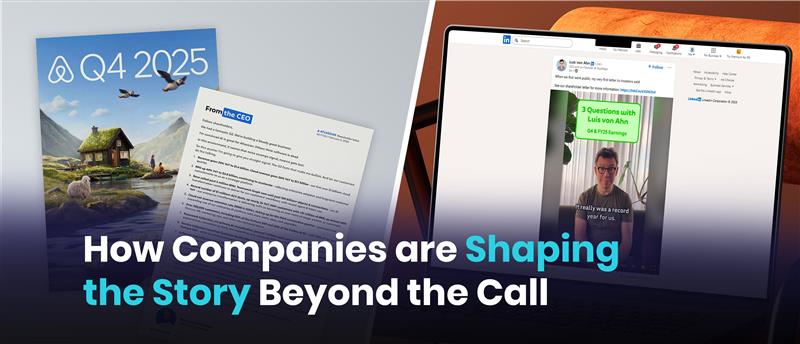
Every quarter, we look at what companies are trying, refining, or doing differently around earnings. This past season, we focused on two tools that are relatively nascent but gaining traction: videos and shareholder letters.

Both give companies more control over the narrative, but in different ways. Shareholder letters create more room for depth and tone than a press release can. Videos do something a written summary cannot. They let investors see whether the confidence behind the words feels real.

Here are some of the most interesting examples from the quarter, each with new learnings worth paying attention to.

More Leaders Are Using Video to Communicate Directly

We saw more companies this earnings season using short videos to let management speak directly to investors. The strongest ones did more than recap the quarter. They clarified the message and gave investors a better sense of how leadership was thinking.

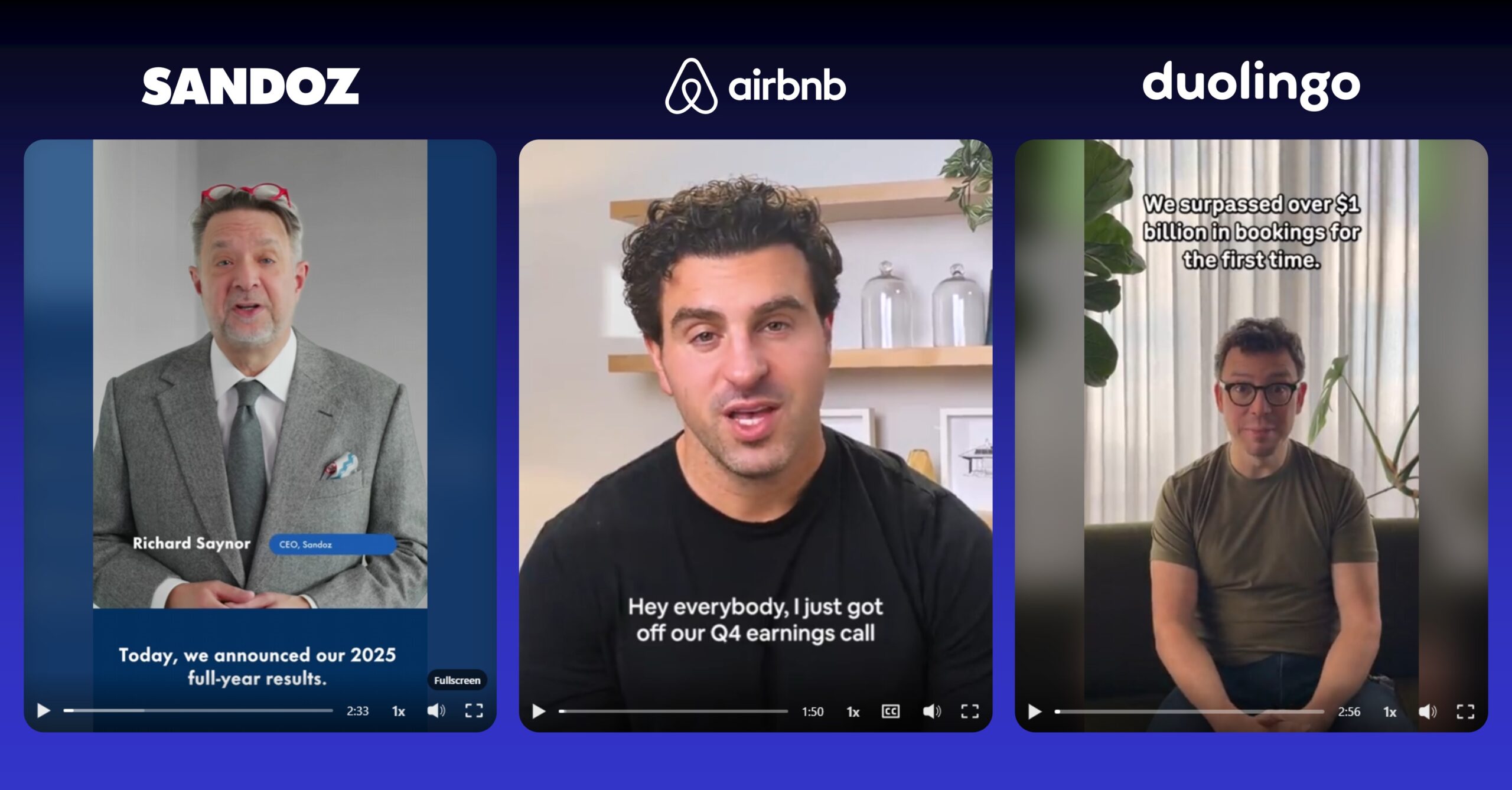
Richard Saynor from Sandoz (watch here) kept it straightforward: headline results and path forward, delivered with confidence and clarity that made the numbers feel credible. Watching him speak created trust that a written summary couldn’t.

Brian Chesky from Airbnb (watch here) barely mentioned the 12% revenue growth. Instead, he focused on what’s happening inside the business to drive future performance: innovation updates, new hires, where they’re doubling down. He used the video to show forward momentum, not just recap the past.

Luis von Ahn from Duolingo (watch here) took a different approach. He didn’t summarize the quarter at all. Instead, text-based questions appeared on screen – concerns the IR team anticipated – and he answered them directly on camera. He explained why Duolingo is reinvesting profits to build “a larger, stronger company in the long term.” He used the video strategically to address investor concerns head-on.

For IROs: These were all 2-3 minutes. The format adds credibility through tone and body language. The best ones went beyond recaps to address what investors actually need to hear: concerns, context, and what’s driving future results.

Shareholder Letters Give You Room for Voice and Context

The shareholder letter isn’t new, but this quarter we saw two companies use it exceptionally well as a replacement for traditional press releases and prepared remarks. The advantage: long-form writing lets you add depth, voice, and context that a bullet-point press release can’t deliver. Done right, you eliminate redundancy – just issue a one-paragraph press release pointing to the letter.

We wrote a detailed breakdown on the case for the earnings shareholder letter that covers why they work and how to structure them.

Airbnb delivered a textbook example. Their Q4 2025 letter (read here) followed the [four-part framework] we often recommend: highlights, business updates, financials, and guidance. Business updates weren’t just announcements – they showed results. Reserve Now, Pay Later launched in the U.S. with over 70% adoption by eligible bookings. Updated cancellation policies reduced customer service contacts and increased bookings. Expansion markets grew at roughly twice the rate of core markets.

The letter gave investors everything they needed: what happened, why it happened, what’s next. Traditional format, executed at the highest level.

Atlassian went bold. CEO Mike Cannon-Brookes opened the Q2 FY25 letter (read here) with: “We had a fantastic Q2. We’re building a bloody great business. I’m convinced AI is great for Atlassian. Others think software is dead.

He acknowledged the noise hitting the SaaS sector, then promised investors “straight signal” – just facts. What followed was a numbered list of 10 quantified results: revenue up 23% to $1.6B, cloud revenue up 26% to $1.1B (their first $1B+ cloud quarter), RPO up 44% to $3.8B (and more).

The tone was unapologetically informal (phrases used included: “bloody great business,” “give a sh*t,” “LFG 👊”). Not saying this approach is right or wrong for everyone – just showing you what Atlassian chose and how they made it work. Customer testimonials weren’t just quotes – they included metrics. E.g., Jira (their software) customers using AI code-gen tools create 5% more tasks, have 5% higher MAU, and expand seats 5% faster. Delivery Hero migrated 40,000 users 40% faster than planned and realized 69% cost and time savings.

He addressed the SaaS sector skepticism directly, then backed every claim with data. The CFO section handled financial rigor. The CEO built the narrative investors needed to separate Atlassian’s story from sector headwinds.

For IROs: Shareholder letters work when you need more depth than a press release allows. They give you room for voice, context, and explanation. Plus, allows for a “visual” story. Use them to replace lengthy press releases and prepared remarks. Structure them using our four-part framework to give investors a document they can digest before and after the call.

Here are a few more resources on earnings comms, if you’d like to explore this further:

➡ Some interesting ways companies are taking the story beyond the call. See examples from [Q3 ‘2025] [Q1 ‘2025]

How Linamar cut their earnings call prepared remarks by 30%. [View the case study]

➡ 4 practical ways to streamline a long earnings call. [See how]

➡ 10 checks to make sure your prepared remarks and slides are telling the same story. [Read more]

Learn more about OUTKREATE’s Investor Relations Solutions

We help Investor Relations teams to ELEVATE presentations for any occasion – be it your novelty Investor Day, General Overview, Quarterly Earnings, Investor Conferences, ESG Updates.

Thinking of UPGRADING your Investor Materials?
TALK THROUGH YOUR PRESENTATION CHALLENGE

How does your Presentation measure up?

Do you have a major event or a high-stakes meeting coming up? Do you need a sharp narrative and bold design?

Let's connect and we can take a closer look at your presentations. We'll share with you actionable ideas along with real examples that you can apply to improve odds of success.

Book an introductory call