In this edition, we share a presentation structure for new item launch decks that get buyers to lean in, not tune out.
For most CPG companies, launching a new product is one of the highest-stakes moments of the year. Months of R&D, consumer testing, and internal alignment have led to this point. And then the meeting with the buyer happens.

The sales team walks in and leads with: “We’re thrilled to introduce our newest innovation.” They walk through the specs, the flavors, the packaging. They close with a distribution ask. The buyer listens politely and nothing much happens or worse, things are moving slowly.

The product might be great. The issue is how it’s being positioned. Most new item presentations answer one question: “What is this product?” But the buyer is asking something very different: “Why should I care? What problem does this solve for my category? Why does this deserve shelf space over what I already carry?”

That gap is where most new item pitches fall apart. ­

So... Let's Flip The Narrative

The best new item launch presentations we’ve built with our clients don’t start with the product. They start with the problem.

Instead of “Here’s what we made, and here’s why it’s great,” the conversation becomes “Here’s what’s happening in your category, and here’s what we built to address it.” When the story is structured this way, the case builds itself.

If you’re in Sales, you already know this instinctively. Your brand teams are focused on the product. You know the meeting needs to be about the retailer. This structure helps you get there.

This article is about the thinking behind the conversation, not just the creation of slides. How you organize your argument shapes how the meeting goes. Consider the presentation as simply the vehicle that helps you deliver that thinking with clarity.

👉 Try This Presentation Outline

[This is what an illustrative Presentation Outline will look like. Take a moment to digest it.]

Think of the presentation as four chapters, with a short opening to set the stage:

Opening: Cover Page + Executive Summary

~ Chapter 1: Situation – Consumer trends, and what’s happening in the category

~ Chapter 2: Problem
– What’s the category (or retailer or shopper) problem

~ Chapter 3: Solution
– Your product, positioned as the solve to the problem

~ Chapter 4: Next Steps
– What you’re asking the buyer to do ­

Next, let’s double-click into each of the chapters ­

Opening: Lead With What's at Stake

Most cover pages read: “Introducing [Brand] [Product].” Product-first from the first slide.

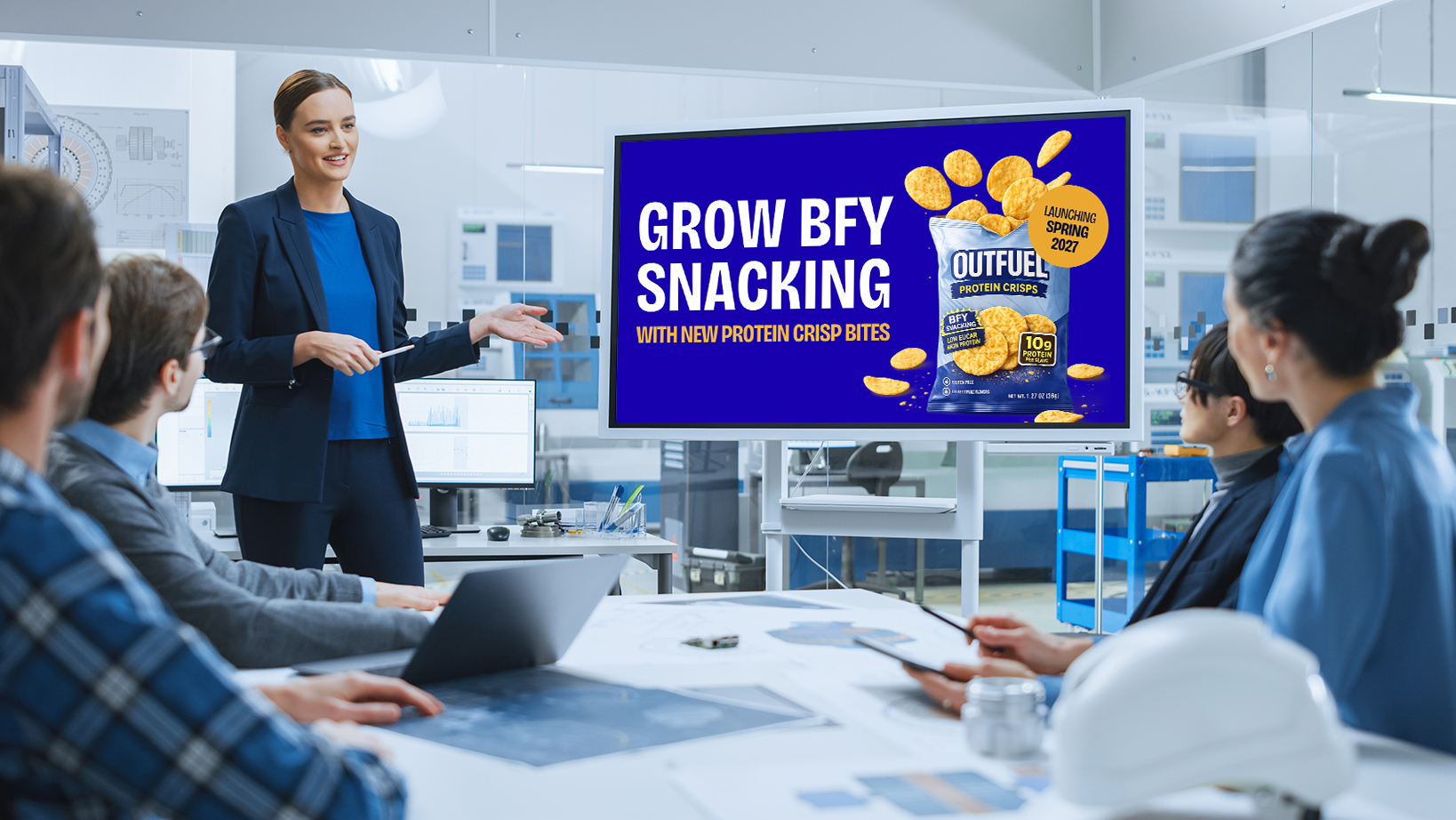
Instead, frame the cover around the category opportunity. In our example, we don’t say,  “Introducing Outfuel Protein Crisp Bites.”. Instead, we say, “Grow BFY Snacking with New Protein Crisp Bites.” One says “look at what we made.” The other says “here’s how we help you grow.” Subtle, but it changes how the buyer receives everything that follows.

Right after the cover, include an Executive Summary. We use a Situation-Problem-Solution-Next Steps format for the executive summary. This is also going to be the order of the presentation. This slide also works like a one-pager, and becomes your insurance policy. Not every meeting gives you 30 minutes. Sometimes you have 5 minutes, and this one-pager does the job as a “teaser” before a deep-dive.

Chapter 1: Set the Situation and Build Credibility

Before you talk about a problem, establish the landscape. This chapter should be tight: two to three slides, max. You’re not giving the buyer a category education.

One approach that works well: start with consumer and shopper trends. If you’re in active nutrition, for example, maybe the trend is that protein has gone mainstream and consumers want options that taste good and fit everyday snacking, not just post-workout routines. From there, double-click into the category itself: how big is it, what’s the HHP, what’s the growth rate? Then break down the key segments to show where the white space or momentum is. Some teams go even deeper here, covering metrics like trips per buyer or shopper decision trees. It depends on your category and what the buyer needs to see.

End of the day, the goal of this chapter is alignment and credibility. You’re saying: “We see what you see. Our thinking is grounded in your reality.” ­ ­

Chapter 2: Define the Problem

This is where most teams lose the plot. They skip straight to “here’s our product.” But when you do that, the buyer has to fill in the gap themselves. The question is: Why does this category need something new? 

State the core problem.

Make it specific and make it matter to the retailer. Maybe household penetration has plateaued. Maybe the category sees trial but not repeat. Whatever it is, it should be a category-level issue, not a brand-level one. A problem that only affects your brand isn’t compelling. A problem that affects the retailer’s ability to grow the category is.

Dig into root causes.

Don’t just state the problem. Explain why it exists. If repeat is declining, why? Maybe innovation has been lacklustre. Maybe consumers crave newer formats. When you can show the buyer not just what is happening but why, you earn the right to present your solution.

Name the innovation gap.

This is the bridge to Chapter 3. For example, if data proves so, you might be saying something like: “Current innovation is not solving for taste or format. There’s a clear opportunity.” That frames your product as the logical next step, not a random launch. ­ ­ 

Chapter 3: Introduce the Solution

Now you’ve earned it. The buyer understands the landscape, agrees the problem is real, and is curious about what you’re proposing.

Start with introducing the product at a high-level, how big is the size of prize, and get into what makes the product uniquely capable of solving the category problem.

Product introduction: Create some energy, but lead with the value proposition, not the SKU. For example: “A $XX million Year 1 opportunity to bring a better-tasting, more snackable format to active nutrition.” The buyer should understand what this product does for their business before they learn what’s in the bag.

Features and benefits: What makes the product unique? Tie everything back to the problem you just defined.

Include the essential item details: Price, size, pack configuration.

Next, develop your most money slides, i.e., Reasons to believe (RTB):

The Reasons to Believe slides answer the buyer’s unspoken question: “How do I know this won’t just sit on the shelf?”

The specific RTBs will vary by product and company. Below are a few of RTBs examples that could work well for your situation:

~ Consumer validation: testing results that show the product is likely to resonate with shoppers
~ Brand equity: if you’re launching under an established brand, show how that brand gives the new item a head start
~ Marketing investment: detail the support behind the launch across social, digital, in-store, and retailer-specific activations

Use the ones that are strongest for your situation, but make sure you have at least two or three solid ones. A product without proof is just a promise, and buyers hear a lot of promises. ­ ­

Chapter 4: Close With Clear Asks

This is the part most teams rush or skip. Don’t.

Be specific with your asks. You want distribution commitment. You want input on items and flavors. You want alignment on shelf placement. Name it. Buyers respect clarity.

Align on timelines. Retailers reset shelves on a predictable cadence. If you’re targeting Spring, be explicit about when you need commitment so the product makes the window. This creates natural urgency without being pushy.

Lock in a follow-up. Don’t leave the next step ambiguous. Propose a date for a deeper dive, a joint planning session, a shelf review. Every day without a follow-up is a day the buyer’s attention drifts.

If you’re presenting at Sweets & Snacks, NACS, or any trade show, time is compressed and the buyer is seeing dozens of pitches. Your asks need to be crisp, your timeline clear, and your follow-up locked before you leave the booth. ­

Why This Structure for Line Reviews Works

It shifts the conversation from “here’s what we made” to “here’s what we built to solve a category or retailer problem.” It keeps the buyer anchored in their own world. It builds trust before it asks for anything. And it makes the close feel natural rather than forced.

We call it the Situation-Problem-Solution-Next Steps framework, and we’ve used it across Line Reviews, JBPs, Top to Tops, and now new item launches. It works because it mirrors how good decisions get made.

It’s the structure we use with our clients, and we’ve pressure-tested it across dozens of launches. If you’re preparing for one and want to sharpen the story, that’s the kind of work we do.

Here are a few more resources on retailer-facing stories, if you'd like to explore this further:

➡️ Why most Line Reviews fall flat, and how to structure them better. [See how]


➡️ How to create a stronger top-to-top story with retailers. [See the framework]

➡️ What Costco buyers look for, and how to build your case around that. [More here]

Learn More About OUTKREATE's Sales, CatMan & Insights Solutions

OUTKREATE develops retailer-facing presentations for top CPG Cat Man & Insights teams, equipping them for success, be it Top to Tops, Innovation Selling Stories, Line Reviews & JBPs, and more.

Thinking of UPGRADING your Retailer-facing Presentation? 
TALK THROUGH YOUR PRESENTATION CHALLENGE

How does your Presentation measure up?

Do you have a major event or a high-stakes meeting coming up? Do you need a sharp narrative and bold design?

Let's connect and we can take a closer look at your presentations. We'll share with you actionable ideas along with real examples that you can apply to improve odds of success.

Book an introductory call