For many CPG teams, the Line Review is one of the highest-stakes meetings of the year.

You have limited time with a powerful buyer. Big decisions are on the table. Distribution, space, innovation, merch / promo plan and investment levels are all in play.

And yet, many Line Reviews don’t help you achieve what you set out to do. 

It could be many reasons. A lot of Line Reviews spend too much time reporting the news and walking through last year’s performance. At times, the Key Account Manager ends up pitching internal priorities, or simply recycling last year’s deck. Often, the story misses a shopper- or retailer-first lens, and the meeting can feel disconnected as different functions take turns presenting (brand, trade, CatMan, eCom, etc.) their own priorities.

The Line Reviews that actually work feel very different.

They are retailer- and category-first, problem-led, and built around one clear, sizable issue the buyer actually cares about.

Below is a simple structure we’ve seen work consistently. It’s not meant to be copied slide-for-slide, but it’s a strong starting point if you want your next Line Review to feel more like a joint business case and less like a routine update.

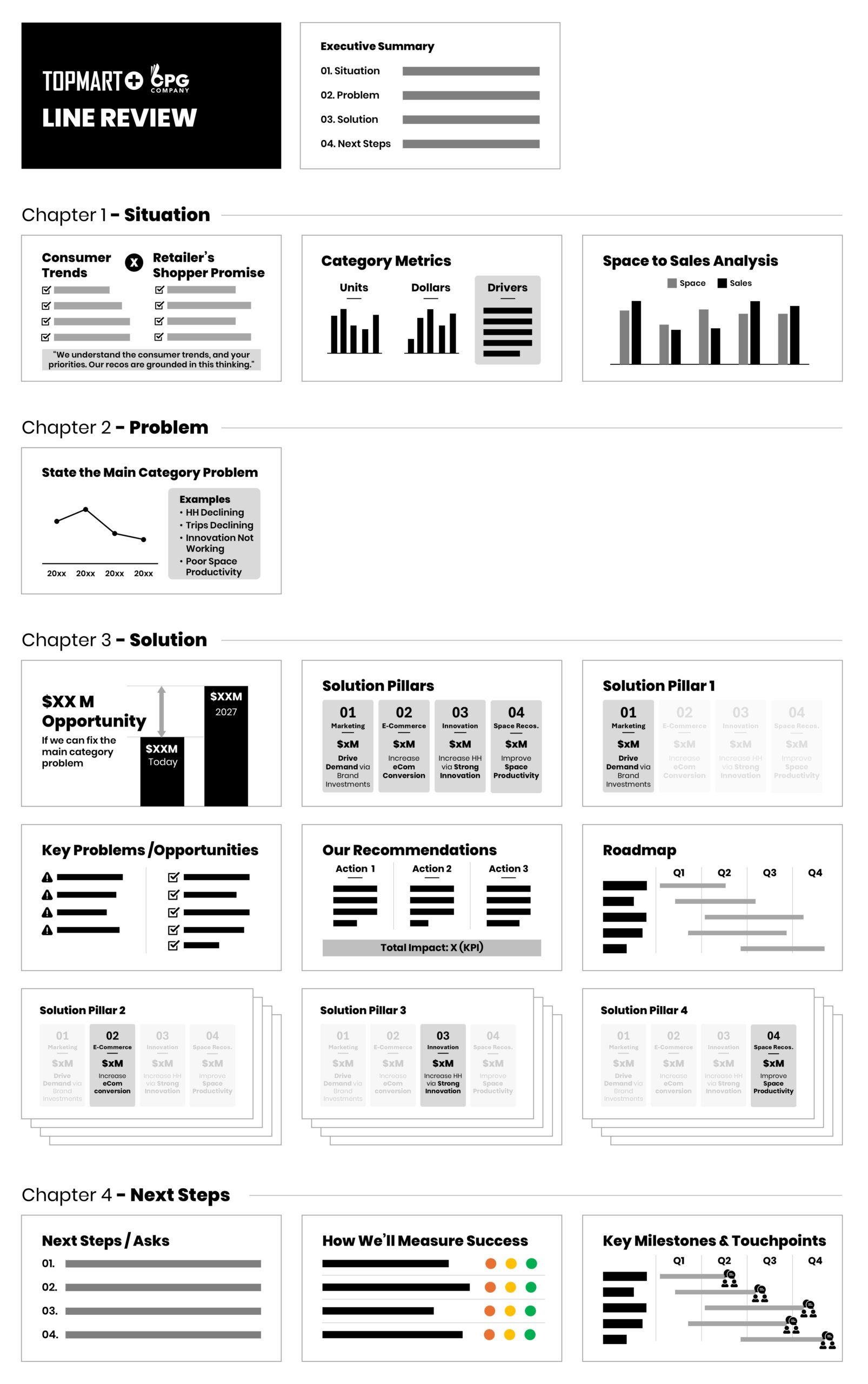
Above is an illustrative presentation outline for a CPG Line Review

A Better Way to Think About a Line Review

At its core, a Line Review should answer three questions for the buyer:

  1. What’s really happening in my category and with my shoppers?
  2. What’s the biggest problem or opportunity I should be focused on?
  3. How do we grow the category profitably together?


Everything else supports those answers.

Here’s how that translates into a clear presentation story (or outline). This isn’t really about “building a Line Review deck.” It’s about structuring the conversation with the buyer. The slides are simply the tool that helps you deliver the thinking with clarity.

The Line Review Story, at a Glance

A strong Line Review has a clear flow, even if the slides themselves vary by retailer or category.

Think of it as four chapters, with a short opening to set expectations before the meat and potatoes of the story begins:

Opening: Executive Summary

Chapter 1: Situation and Context

Chapter 2: The Category or Shopper Problem

Chapter 3: The Opportunity and Solution

Chapter 4: Next Steps and Asks

Opening: Start With an Executive Summary, Not an Agenda​

Too many line reviews open with an agenda or a roll call of who is presenting.

Instead, start with a tight executive summary that sets the direction for the meeting. 

The biggest shift is this:

You don’t keep the buyer waiting or anticipating what this is about. You start by telling her / him why you’re here and where the conversation is headed upfront, then walk them through a logical story that builds toward alignment.

A strong executive summary answers three things upfront:

  • What’s changed in the category or shopper behavior?
  • What problem or opportunity you’ve identified?
  • What you’re proposing to do about it together?

This reframes the meeting from “here are our updates” to “here’s the opp’ty for you, and the decision we want to align on,” before you get into the details.

Chapter 1: Set the Situation and Build Credibility

Start by grounding the buyer in context. Don’t drown them in 10–20 slides of data. Chapter 1 should be fast: build rapport, establish credibility, and show you understand their world. This can be done in 2-3 slides max.  

This chapter often includes:

  • Consumer and shopper trends: What’s changing in how consumers behave in your category, what they want, and how they buy.
  • Retailer priorities: You’ve done your homework. You share what the buyer (retailer) is trying to solve for right now. You’ve been through the retailer’s website or Investor relations page. You know what’s top priority for them, e.g., Price perception, space productivity, traffic, margin, or differentiation.
  • Category performance: A concise view of most important category KPIs. Keep this tight. Long performance recaps burn time and rarely change minds. (move “nice to have” slides to Appendix if need be).

The goal here is alignment and trust. You’re saying, “We see what you see, and we’re building from that.”

Chapter 2: Define a Clear Category or Shopper Problem

This is where many Line Reviews lose focus.

Instead of moving straight into “here’s my innovation lineup”, pause and define the core issue.

Identify and define a strong problem. These tend to be:

  • Category-level, not brand-level
  • Shopper-driven, not internally convenient
  • Big enough to matter

Examples might include:

  • Declining trips or household penetration
  • Underperforming ecommerce conversion
  • Weak innovation productivity
  • Poor space efficiency

If the buyer agrees the problem is real, you’ve earned the right to talk about your recommended solutions.

Chapter 3: Frame the Opportunity and Present the Solution

Once the problem is clear, quantify the opportunity.

If solving this issue could unlock $20M, $30M, or $50M in incremental category growth over time, say it. Buyers pay attention when the scale is clear.

From there, organize your recommendations into a small number of solution pillars that directly address the problem.

This is also where the Line Review breaks away from the usual internal agenda. Too often, teams default to a functional roll-call (“brand presents, then e-com, then cat man…”). Instead, the pillars should come first, based on what will actually solve the buyer’s problem. The presenters earn their place because they own a meaningful lever, not because it’s simply their turn.

Your Solution Pillars might include areas like:

  • Innovation
  • Marketing and demand creation
  • Ecommerce
  • Assortment optimization
  • Space and shelving principles

Not every line review needs every pillar. The example shown here includes four solution pillars, each sized at a specific dollar opportunity, but your actual presentation might include 3 to 5, depending on the category problem you’re solving.

What matters is that each pillar clearly ties back to the core problem and opportunity.

For each pillar, a simple structure works well:

  • What’s working /what isn’t today; what’s the opportunity
  • The specific recommendations
  • The expected impact
  • A high-level action plan

And this is where the real work begins.

The outline is just the skeleton, but the substance comes from the quality of your solutions.

This is the chapter where you need to do the heavy lifting: dig into the data, pressure-test your assumptions, involve the right internal experts, and build recommendations that genuinely move the retailer’s business forward.

Chapter 4: Close the Loop With Clear Asks and Next Steps

One of the most common misses in line reviews is the close.

Teams run out of time. The last pillar wraps up. The meeting ends.

A strong line review deliberately protects time to:

  • Recap the recommendations
  • Confirm alignment
  • Clarify what’s approved, what needs refinement, and what’s next

Reserve the final 10-15 minutes specifically for this discussion, even if it means shortening or deferring a solution pillar. If you’re in a 60-minute meeting, plan to start the close by minute 45. If time is tight, it’s always better to defer a pillar than to skip the close. Alignment is where value is created.

This is also where you define success metrics and key milestones so accountability is shared, not assumed.

Why This Structure for Line Reviews Works

This approach:

  • Shifts the meeting from reporting last year’s results to driving decisions for the year ahead
  • Keeps the buyer anchored around one clear, meaningful category or shopper problem
  • Frames your recommendations (e.g., innovation, promotion, space, investment) as solutions to that problem, not a list of internal priorities
  • Increases the likelihood of real alignment, commitment, and follow-through after the meeting

It’s the structure we use as a starting point with clients, then tailor based on the retailer, category, and stakes of the meeting.

If you have a high-stakes Line Review coming up, this framework is a solid place to start. Adapt it, pressure-test it, and make it your own.

And if you want a second set of eyes on the story before you walk into the room, feel free to reach out.

Learn More About OUTKREATE's Sales, CatMan & Insights Solutions

OUTKREATE developes retailer-facing presentations for top CPG Cat Man & Insights teams, equipping them for success — be it Top to Tops, Innovation Selling Stories, Line Reviews & JBPs, and more.

Thinking of UPGRADING your Retailer-facing Presentation? 
TALK THROUGH YOUR PRESENTATION CHALLENGE

How does your Presentation measure up?

Do you have a major event or a high-stakes meeting coming up? Do you need a sharp narrative and bold design?

Let's connect and we can take a closer look at your presentations. We'll share with you actionable ideas along with real examples that you can apply to improve odds of success.

Book an introductory call