Whether you lead category management, sales, trade marketing, or RGM, the leaders who build and sell a strong vision for their function are the ones who move the needle. Those teams become more strategic with their retail partners and solve bigger problems, and sr. leadership starts to see those functions as a true growth driver.
And yet, vision work is usually the first thing pushed aside for the next urgent request. The day-to-day keeps pulling you into reactive mode, and the strategic work that would actually change your trajectory stays on the back burner.
Here’s what we’ve found: most leaders already have a clear sense of their vision. The challenge is articulating it in a way that gets people on board. That’s where the “Vision presentation” becomes the vehicle: turning what’s in your head into a story others can act on.
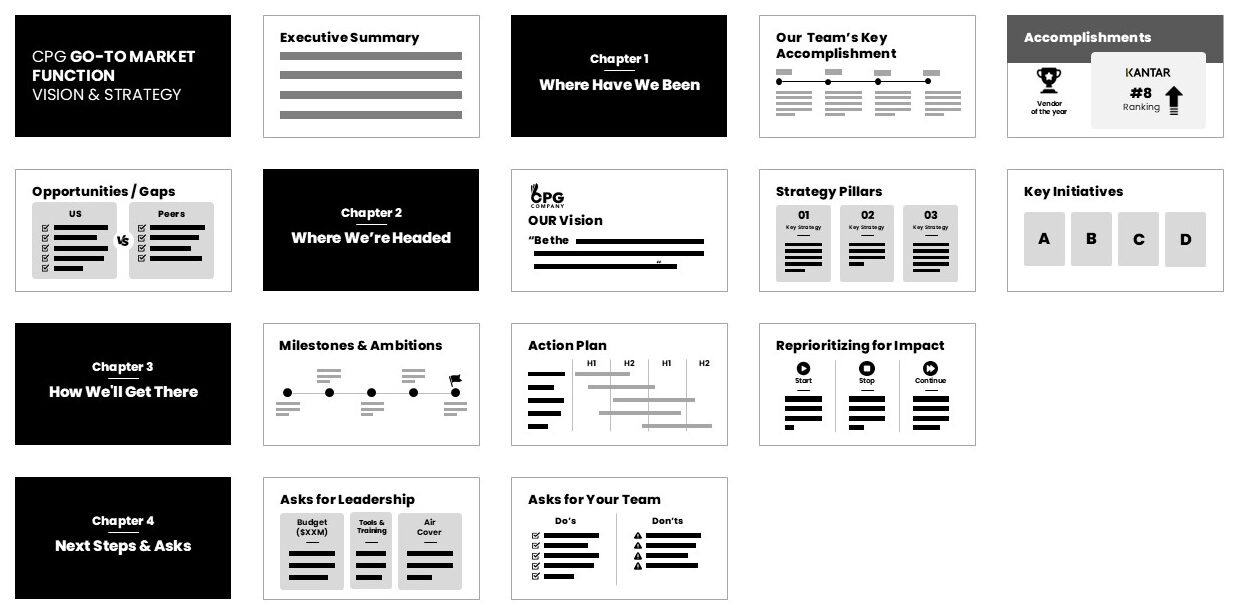
We recently worked on a Vision story for the head of Cat Man at a large snacking CPG. The deck had these 3 main chapters. This structure and ideas we share can serve as a strong starting point if you’re due to build a Vision for your team.
Chapter 1: Where you’ve been. Highlight the wins (e.g, customer recognitions, a strategic initiative win w/ a retailer) and acknowledge the gaps (a lagging Kantar or Advantage ranking, not having a seat at the table w/ a key retailer). Use both to make the case for change.
Chapter 2: Where you’re headed. Articulate your vision, i.e., what your team should stand for over the next 2 to 3 years, supported by 3 to 4 bold pillars. The strongest pillars tend to be outward-facing, e.g., lead with an external lens (shopper, consumer, and retailer insights first), elevate category execution (e.g., elevate shopability, optimize space), and build team capabilities (e.g., AI, storytelling, analytics).
Chapter 3: How you’ll get there. Lay out milestones with ambitions, e.g., improved retailer rankings, new captaincies, test-and-learns that prove the approach. Time and resources will always be a constraint, so address it head-on. A Start / Stop / Continue reset can help your team reprioritize, freeing time for the higher-impact work your vision calls for.
Closing: End with your asks. If you’re presenting to leadership, ask for what you need: budget, tools, training, air cover to remove barriers. If you’re rallying your team, the ask is: change how you work, move beyond “rates and dates,” and lean into deeper retailer influence.
Below is a presentation outline that maps these chapters to suggested slides. It’s based on a real exercise, so adapt it to fit your situation.